
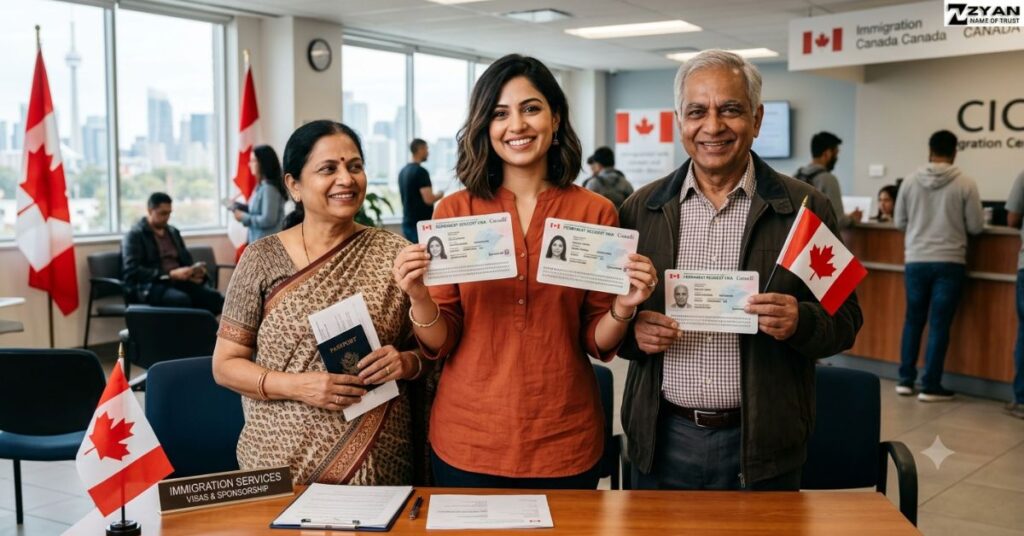
Canada Parent Migration Visa is one of the most emotionally powerful, and procedurally complex, immigration pathways available. This guide covers everything Indian PR holders need to know to reunite their families the right way.
The Canada Parent Migration Visa is the dream of millions of Indian immigrants. After years of building a new life in Canada, earning PR status, settling into a home, starting a career, the one thing that still feels missing for many Indian families is having their parents nearby. And Canada, to its credit, has built dedicated pathways to make that reunion possible.
But the Canada Parent Migration Visa process is not simple. It is a competitive, document-intensive, income-sensitive process with two distinct pathways, each with its own rules, timelines, and eligibility requirements. Getting it wrong means delays, refusals, and months of separation from the people you love most.
This guide breaks down every aspect of the Canada Parent Migration Visa, from choosing the right pathway and meeting the income requirements to understanding the hidden costs and avoiding the most common mistakes. Whether you are just starting to explore the idea or are ready to file your application, this is the complete resource for Indian PR holders who want to sponsor parents to Canada successfully.
The Two Pathways to a Canada Parent Migration Visa: PGP vs Super Visa
When it comes to bringing your parents to Canada, there are two official routes under the Canada Parent Migration Visa framework. They are designed for different needs, different timelines, and different long-term goals.
Pathway 1: Canada Parents and Grandparents Program (PGP)
The Canada Parents and Grandparents Program (PGP) is the permanent residency pathway. Under PGP, you sponsor your parents or grandparents to become permanent residents of Canada, giving them the same healthcare, social benefits, and right to live and work in Canada that you enjoy as a PR holder. The PGP is administered by Immigration, Refugees and Citizenship Canada (IRCC) and is subject to annual intake caps.
The Canada Parents and Grandparents Program operates through a lottery-style Interest to Sponsor (ITS) process. IRCC periodically opens an online pool and randomly selects eligible sponsors to submit a full sponsorship application. This randomised intake system means that even perfectly eligible sponsors may wait multiple years before receiving an invitation.
Key facts about the PGP pathway
- Outcome: Permanent residency for sponsored parents and grandparents
- Annual intake: IRCC announces caps each year (typically 15,000–30,000 spaces)
- Process: Interest to Sponsor (ITS) pool → random selection → invitation to apply → full application
- Processing time: 20–36 months from invitation to PR approval (varies significantly by year)
- Undertaking period: Sponsor must financially support parents for 20 years after PR grant
- Cost: Application fee of CAD 1,085 per applicant (sponsor) + CAD 540 per sponsored person (subject to change)
- Right to work: Yes, parents can work in Canada with PR status
- Healthcare: Yes, full provincial health insurance coverage
Pathway 2: Super Visa Canada for Parents
The Super Visa Canada for Parents is a long-stay multi-entry visitor visa that allows parents and grandparents to visit Canada for up to 5 years at a time (extended from the previous 2-year limit as of July 2022), with the visa itself valid for up to 10 years. It is faster to obtain than the PGP, does not require an ITS lottery, and is an excellent option for families who want their parents close without necessarily pursuing permanent residency.
Key facts about the Super Visa pathway
- Outcome: Long-stay visitor status (not PR), parents can visit for up to 5 continuous years per entry
- Visa validity: Up to 10 years (multi-entry)
- Processing time: 2–8 weeks (often much faster than PGP)
- No lottery required: Apply directly through IRCC’s online portal
- Insurance requirement: Minimum CAD 100,000 private medical insurance coverage for each parent
- Right to work: No, Super Visa is a visitor visa; parents cannot work
- Healthcare: No provincial coverage, parents must carry private insurance throughout their stay
- Cost: CAD 100 per person application fee + cost of private insurance (CAD 1,500–3,500 per year per person)
PGP vs Super Visa: which Canada Parent Migration Visa pathway is right for you?
Factor | PGP (Permanent Residency) | Super Visa (Long-Stay Visit) | Best choice if… |
Timeline | 3–5+ years | Weeks to months | Urgent: Super Visa |
Outcome | Permanent residency | Visitor status | Long-term: PGP |
Income requirement | LICO 3-year average | LICO current year | Lower income: Super Visa (single year) |
Healthcare | Provincial plan (free) | Private insurance (paid) | No budget for insurance: PGP |
Parents’ right to work | Yes (with PR) | No | Parents want to work: PGP |
Certainty | Lottery — not guaranteed | Direct application | Reliability: Super Visa |
Long-term cost | Lower (healthcare covered) | Higher (ongoing insurance) | Budget-conscious: PGP eventually |
Repeat visits | Permanent right to stay | Can re-enter anytime within 10yr validity | Flexible: Super Visa |
Zyan Immigration Tip: Many Indian PR holders apply for a Super Visa first to get their parents to Canada quickly while simultaneously entering the PGP pool to secure permanent residency for them long-term. This dual-track strategy is the most practical approach for most families.
Parent Sponsorship Requirements Canada: Who Can Sponsor and Who Can Be Sponsored
Who is eligible to sponsor under the Canada Parent Migration Visa?
Not every Canadian PR holder can automatically access the Canada Parent Migration Visa program. There are specific eligibility criteria for the sponsor, the Indian PR holder in Canada, that must be met before any application can proceed.
Sponsor eligibility requirements
- You must be a Canadian citizen or permanent resident (PR) aged 18 or above
- You must be residing in Canada, sponsors living abroad are not eligible
- You must not be in receipt of social assistance (except disability-related assistance)
- You must meet the minimum necessary income (LICO) threshold, the most critical parent sponsorship requirement Canada imposes
- You must not have a previous sponsorship undertaking that is in default
- You must not have been convicted of certain criminal offences (particularly those involving violence or sexual offences)
- You must not be bankrupt or insolvent
- You must be the child or grandchild of the person you are sponsoring
Who can be sponsored under the Canada Parent Migration Visa?
- Parent, your biological mother and/or father
- Stepparents, if legally recognised
- Adoptive parents
- Grandparents, paternal or maternal
- The sponsored person’s accompanying spouse or common-law partner
- The sponsored person’s dependent children
Important: Only one person can sponsor a particular parent. If both you and a sibling in Canada want to include the same parent in a Canada Parent Migration Visa application, only one of you can be the primary sponsor, the other can be a co-signer of the undertaking.
What are the parents’ eligibility requirements?
Parents being sponsored under the Canada Parent Visa must meet standard IRCC admissibility criteria, which include passing security and background checks, completing medical examinations, and having no outstanding immigration violations. For Indian parents specifically, the medical examination is conducted by an IRCC-approved panel physician, the list of approved physicians in India is available on the IRCC website.
- Medical examination: Required, completed by an IRCC-designated panel physician in India
- Police clearance certificate: Required, from India (CBI or state police) and any other country where parents have lived for 6+ months
- Biometrics: Required for PGP; not required for Super Visa (biometrics collected at Canadian border)
- No outstanding immigration violations: Parents must not have previously been deported from or denied entry to Canada
Income Requirements for Canada Parent Migration Visa: The LICO Test Explained
The most demanding parent sponsorship requirement Canada places on sponsors is the income threshold, commonly called the LICO, Low Income Cut-Off. This is the minimum income a sponsor must demonstrate to prove they can financially support their parents without those parents becoming a burden on Canadian social services.
How the LICO test works for PGP
For the Canada Parents and Grandparents Program, the LICO test requires you to demonstrate that your total income across the three most recent tax years has been at least 30% above the LICO threshold for your family size in each of those three years. You cannot average the three years, you must meet the threshold in all three individually.
2024 LICO thresholds for PGP sponsors (approximate, verify with IRCC for current year)
Family size (sponsor’s household + sponsored persons) | Minimum income required (30% above LICO) |
2 persons | CAD 41,007 |
3 persons | CAD 50,414 |
4 persons | CAD 61,209 |
5 persons | CAD 69,415 |
6 persons | CAD 78,293 |
7 persons | CAD 87,172 |
Each additional person | + CAD 8,878 |
Note: ‘Family size’ includes the sponsor, their spouse/common-law partner (if applicable), all dependent children, and the persons being sponsored. For example, an Indian PR holder sponsoring both parents has a minimum family size of three, the sponsor, the mother, and the father, which means meeting the 3-person LICO threshold.
Proof of income documents required
- Notice of Assessment (NOA) from the Canada Revenue Agency (CRA) for the 3 most recent tax years
- T1 General tax returns (if NOA is not available)
- T4 slips (employment income) or T1 business income schedules
- Employment letter confirming current employment and salary (additional supporting document)
How the LICO test works for Super Visa Canada for Parents
The income requirement for the Super Visa Canada for Parents is based on a single year’s income, specifically, the most recent tax year. This makes the Super Visa significantly more accessible for Indian PR holders who are newer to Canada or whose income varied significantly in earlier years.
The required income for Super Visa Canada for Parents follows the same LICO thresholds but applied to just the most recent year, not three years. Additionally, the income of a co-signing spouse in Canada can be combined with the primary sponsor’s income, further reducing the threshold barrier for dual-income households.
Pro Tip for Indian Families: If you have recently received a salary increase, changed jobs for significantly higher pay, or recently started a second income stream, the Super Visa’s single-year income test may be much easier to pass right now than the PGP’s 3-year average. Check your most recent NOA before deciding which pathway to pursue first.
How to Apply for the Canada Parent Migration Visa: A Step-by-Step Guide
Applying for the PGP: step by step
Step 1: Wait for the Interest to Sponsor (ITS) pool to open
IRCC opens the ITS pool on an irregular basis, typically once per year but not always. The opening is announced on the IRCC website and on the Canada.ca newsletter. When the pool opens, you have a short window (often 48–72 hours) to submit your Interest to Sponsor form online. The form itself is simple, it is the waiting to be selected that is the challenge of this route to the Canada Parent Migration Visa.
Step 2: Get selected and receive an Invitation to Apply (ITA)
IRCC randomly selects sponsors from the ITS pool up to the annual cap. If selected, you receive an Invitation to Apply (ITA) giving you 60 days to submit a complete sponsorship application. Missing this 60-day window means starting over.
Step 3: Gather and submit your full sponsorship application
- Completed sponsorship application forms (IMM 1344, IMM 5768, IMM 0008)
- Proof of Canadian citizenship or PR status, PR card or citizenship certificate
- 3 years of Notice of Assessments from CRA confirming LICO compliance
- Parent sponsorship undertaking, legally binding commitment to support your parents for 20 years
- Sponsor’s relationship proof to the principal applicant, birth certificates linking you to your parents
- Police clearance certificates for parents, from India and any other country where they have lived
- Medical examination results, completed by IRCC-approved panel physician in India
- Photographs, meeting IRCC’s exact photo specifications
- Application fee payment confirmation
Step 4: Wait for IRCC processing
PGP processing times vary significantly by intake year and application volume. Once IRCC receives a complete application, they review it, may request additional documents, and will issue a Confirmation of Permanent Residence (COPR) upon approval. Your parents will also receive their PR visas at the local Canadian visa office, in India, this is typically the High Commission of Canada in New Delhi or the Consulate General in Mumbai or Chandigarh.
Step 5: Your parents land in Canada and activate PR status
Upon first landing in Canada, your parents present their COPR and PR visa at the port of entry. An immigration officer will verify the documents, take biometrics, and confirm permanent resident status. Your parents will then receive their PR cards within 6–8 weeks by mail.
Applying for the Super Visa Canada for Parents: step by step
Step 1: Confirm eligibility and gather documents
- Your most recent NOA showing income above the applicable LICO threshold
- A signed letter from you to your parents confirming sponsorship of their visit
- Proof of your relationship to the applicants, your birth certificate
- Private health insurance policy for each parent, minimum CAD 100,000 coverage, Canadian company, valid for minimum 1 year from date of entry
- Parent’s completed application forms, IMM 5257 (Visitor Visa), IMM 5645 (Family Information)
- Parent’s valid Indian passport with at least 6 months validity beyond intended stay
- Parent’s recent photographs meeting IRCC specifications
- Proof of parents’ ties to India, property, pension, return ticket
Step 2: Submit online or through VFS
Applications for the Super Visa Canada for Parents can be submitted online through the IRCC portal (preferred, and generally faster) or through a Visa Application Centre (VFS Global). In India, VFS operates at multiple locations including New Delhi, Mumbai, Bangalore, Chennai, Hyderabad, Kolkata, Ahmedabad, Chandigarh, and Pune.
Step 3: Biometrics
First-time Super Visa applicants aged 14–79 must provide biometrics. This is done at the VFS Global Application Centre. Biometrics are valid for 10 years once collected, so if your parents have previously provided biometrics for a prior Canadian visa, they may not need to do so again.
Step 4: Wait for processing and collect visa
Super Visa processing times are considerably faster than PGP, typically 2–8 weeks for online applications from India. The visa is stamped in the parent’s passport. Upon arrival in Canada, border services officers confirm the entry and grant the initial stay of up to 5 years.
Hidden Costs of the Canada Parent Migration Visa: What Indian Families Don't Plan For
Cost comparison: PGP vs Super Visa for a family of two parents
Cost item | PGP (both parents) | Super Visa (both parents, per year) |
Application fees (IRCC) | CAD ~3,250 (sponsor + 2 applicants) | CAD 200 (two parents) |
Medical exams (India) | INR ~10,000–15,000 per person | Not required |
Police certificates | INR ~3,000–5,000 per person | INR 3,000–5,000 per person |
Private health insurance | Not required (provincial after PR) | CAD 1,500–3,500 per person per year |
Translation and notarisation | INR 5,000–15,000 | INR 3,000–8,000 |
Immigration consultant fees | INR 40,000–80,000 | INR 15,000–30,000 |
Flight tickets (initial) | INR 60,000–1,20,000 return | INR 60,000–1,20,000 return |
Settlement in Canada | CAD 3,000–8,000 first year | CAD 1,000–3,000 per visit |
The 20-year undertaking: what PGP sponsors must understand
One of the most significant, and most misunderstood, elements of the Canada Parent Migration Visa PGP pathway is the undertaking. When you sponsor your parents for permanent residency, you sign a legally binding 20-year undertaking committing to provide for their financial needs, including food, shelter, clothing, and personal requirements, for two decades.
This does not mean your parents cannot access Canadian social services, with PR status, they are entitled to most public services. What it means is that if your parents ever claim social assistance (with the exception of certain disability benefits), the Canadian government can pursue you for repayment. The undertaking also transfers with you even if you leave Canada.
The 20-year undertaking is one of the most serious legal commitments in Canadian family immigration. Before signing, discuss it thoroughly with your immigration consultant. Zyan Immigration advises all PGP clients on the full implications of this undertaking as part of their standard pre-application consultation.
Healthcare costs during the Super Visa stay
Because Super Visa Canada for Parents holders do not have PR status, they are not covered by Canada’s provincial health insurance system. The mandatory CAD 100,000 private insurance is not optional, it is a non-negotiable condition of the visa itself. But what many Indian families underestimate is how quickly medical costs escalate for elderly parents.
A single hospital admission in Canada for a serious condition can cost CAD 10,000–50,000 or more. Annual private insurance for a 65+ year-old Indian parent typically runs CAD 2,500–4,500 per year. For two parents over 70, that can exceed CAD 8,000–10,000 annually, a cost families must plan for as long as the Super Visa is being used instead of pursuing PGP.
Common Mistakes When Applying for the Canada Parent Migration Visa
Mistake 1: Missing the ITS pool window
The Canada Parents and Grandparents Program pool often opens with less than 48 hours of advance notice. Indian PR holders who are not actively monitoring the IRCC website or are not registered for IRCC email alerts frequently miss the window entirely. The ITS pool can close within hours of opening, sometimes on the same day.
Mistake 2: Incorrect income calculations
Many first-time Canada Parent Migration Visa applicants calculate their family size incorrectly, forgetting to count their own children, underestimating how many people are covered by the undertaking, or miscalculating the 30% LICO premium. An income that appears sufficient turns out to fall short once the full family count is correctly applied.
Mistake 3: Purchasing non-compliant health insurance for Super Visa
For the Super Visa Canada for Parents, the insurance must be from a Canadian insurance company, policies issued by Indian insurers, even comprehensive ones, are not accepted. The minimum coverage of CAD 100,000 must be clearly stated, and the policy must cover the parent’s entire stay from the date of entry. Policies with exclusions for pre-existing conditions must be reviewed carefully.
Mistake 4: Not disclosing parents’ complete medical history
The medical examination for the Canada Parent Visa PGP pathway must be conducted by an IRCC-designated panel physician and must reflect the parents’ complete and honest medical history. Failing to disclose pre-existing conditions, common chronic conditions like diabetes, hypertension, or heart disease, during the medical exam can result in misrepresentation findings that not only reject the current application but may affect future admissibility to Canada.
Mistake 5: Attempting to do it alone
The Canada Parent Migration Visa process, particularly the PGP, involves dozens of forms, strict timelines, income threshold calculations, legal undertakings, and coordination between Canadian and Indian documents. Indian PR holders who attempt to manage this process without professional guidance consistently report higher error rates, missed deadlines, and failed applications. The cost of a single rejected application, in fees, time, and emotional cost, far exceeds the cost of professional help.
How Zyan Immigration Helps You Navigate the Canada Parent Migration Visa
Zyan Immigration is one of India’s most trusted immigration consultants, with 1058+ verified 5-star reviews on Google and Trustpilot. With headquarters in New Delhi and branches across India, Nepal, the USA, and Dubai, Zyan Immigration has guided thousands of Indian PR holders through every aspect of Canadian immigration, including the Canada Parent Migration Visa for both PGP and Super Visa applications.
What Zyan Immigration does for Canada Parent Migration Visa clients
- Free eligibility assessment, full review of your income, family size, and immigration status to determine the best pathway for your family
- ITS pool monitoring, Zyan Immigration monitors IRCC’s system and alerts registered clients when the PGP pool opens, ensuring no client misses the window
- Income threshold review, precise calculation of your required LICO income including all family members, with NOA review
- Document preparation, complete document checklist, preparation support, and quality check for both PGP and Super Visa applications
- Insurance guidance, identifying the right Canadian insurance providers and policies for Super Visa compliance at the best premiums
- Form completion review, every IRCC form reviewed for accuracy and consistency before submission
- Undertaking advisory, full explanation of the 20-year financial undertaking and its legal implications
- Post-submission follow-up, tracking application status with IRCC and responding to any additional document requests
- Sponsor Parents to Canada from India specialist, dedicated team familiar with Indian-specific document requirements, panel physicians, police certificates, and VFS procedures
Ready to bring your parents to Canada? Book a free consultation with Zyan Immigration at zyanimmigration.com or call 011 69269656. Their Canada Parent Migration Visa specialists are ready to guide your family every step of the way.
Recent Changes to the Canada Parent Migration Visa Program You Must Know
Super Visa maximum stay extended to 5 years
Since July 4, 2022, the maximum period of stay per entry under the Super Visa Canada for Parents was extended from 2 years to 5 years. This is a significant improvement that allows Indian families to plan longer visits for their parents without the need for repeated departures and re-entries.
Super Visa insurance can now be from non-Canadian providers (limited circumstances)
As of December 2022, IRCC updated the Super Visa Canada for Parents requirements to allow insurance purchased from companies outside Canada, provided the policy meets all other requirements (minimum CAD 100,000 coverage, valid for at least 1 year, emergency medical coverage). This has opened the door to some Indian insurers’ emigrant policies, but verification of compliance with all Super Visa insurance conditions remains essential before purchasing.
PGP annual intake caps have fluctuated significantly
The Canada Parents and Grandparents Program has seen its annual intake caps fluctuate dramatically in recent years, ranging from 10,000 to 30,000 spaces depending on the year. The higher the cap, the better your statistical chances of being selected from the ITS pool. Staying current with IRCC’s annual immigration levels plan is essential for anyone pursuing the PGP route to Canada Parent Migration Visa.
Frequently Asked Questions:
What is the Canada Parent Migration Visa and who can apply for it?
The Canada Parent Migration Visa refers to the two official IRCC pathways that allow Canadian PR holders and citizens to bring their parents and grandparents to Canada, the Canada Parents and Grandparents Program (PGP) for permanent residency, and the Super Visa Canada for Parents for long-stay visits of up to 5 years per entry. Any Canadian PR holder or citizen aged 18+ who meets the income (LICO) requirements can apply to sponsor their parents under either pathway.
What is the difference between the PGP and the Super Visa for parents?
The Canada Parents and Grandparents Program (PGP) grants permanent residency to sponsored parents, giving them the right to live, work, and access Canada’s public healthcare system indefinitely. The Super Visa Canada for Parents is a long-stay multi-entry visitor visa, parents can stay for up to 5 years per entry and the visa is valid for up to 10 years, but parents do not get PR status, cannot work, and must carry private health insurance. The PGP is ideal for long-term family reunification; the Super Visa is ideal for extended visits while waiting for PGP or as an alternative to permanent sponsorship.
How much income do I need to sponsor my parents under the Canada Parent Migration Visa?
For the PGP, you must demonstrate income at least 30% above the Low Income Cut-Off (LICO) for your family size in each of the 3 most recent tax years. For example, sponsoring both parents as a family of three (you plus two parents) requires a minimum income of approximately CAD 50,414 per year (based on 2024 thresholds, verify current amounts with IRCC). For the Super Visa, only the most recent year’s income is assessed, and co-signer income can be combined. Exact thresholds are updated annually by IRCC.
How long does the Canada Parent Migration Visa process take?
The Super Visa Canada for Parents typically takes 2–8 weeks to process for Indian applicants applying online. The PGP is significantly longer, from receiving an Invitation to Apply (ITA) to PR approval typically takes 20–36 months. The wait to receive an ITA itself is unpredictable; some sponsors wait 1–2 years, others have waited significantly longer depending on the annual intake cap and pool randomisation.
What documents do I need to sponsor parents to Canada from India?
For PGP, key documents include: your Canadian PR card or citizenship certificate, 3 years of Notices of Assessment from CRA, a signed parent sponsorship undertaking, birth certificates linking you to your parents, police clearance certificates from India for your parents, and IRCC-approved panel physician medical exams for your parents. For Super Visa, key documents include: your most recent NOA, a signed invitation letter, proof of Canadian insurance for your parents (minimum CAD 100,000), and your parents’ completed visa application forms, photographs, and valid Indian passports.