
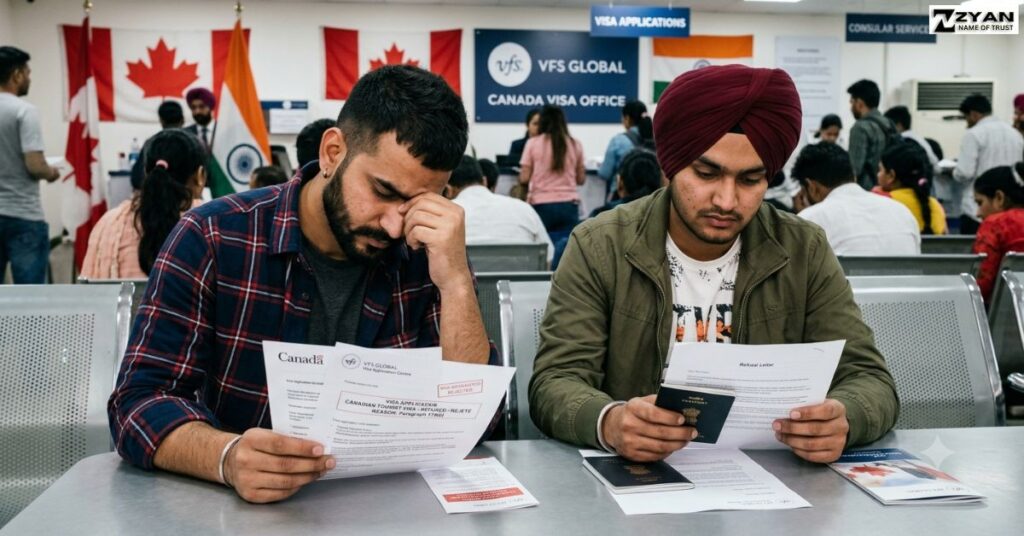
Canada tourist visa rejection rate 2026 is something every Indian applicant needs to understand before submitting a single form. Canada’s Temporary Resident Visa, commonly called the Canada tourist visa or Canada visitor visa, has historically carried one of the higher refusal rates among popular destination countries for Indian nationals, with rejection percentages that have fluctuated significantly depending on processing volumes, policy updates, and the IRCC’s (Immigration, Refugees and Citizenship Canada) annual planning targets.
Understanding the Canada tourist visa rejection rate 2026 is not about finding a workaround, it is about understanding exactly what IRCC officers evaluate, why Indian applications specifically trigger higher scrutiny, and how a well-prepared application can legitimately improve your Canada tourist visa approval chances significantly. This is the complete guide, built around real data, real refusal patterns, and real solutions.
Canada Tourist Visa Rejection Rate 2026: The Real Numbers for Indian Applicants
The Canada visitor visa refusal rate for Indian nationals has consistently ranged between 25% and 40% in recent years, meaning that between one in four and one in three Indian applicants receives a refusal. In some periods and processing batches, particularly during post-pandemic application surges, the Canada visa rejection rate for Indian applicants has exceeded 40%.
Why is the refusal rate so high for Indians?
The elevated Canada tourist visa rejection rate 2026 for Indian nationals is not arbitrary discrimination. It reflects a specific set of risk factors that IRCC officers are trained to assess, including India’s large diaspora and historical overstay patterns, the high volume of Canadian PR applicants applying on tourist visas (raising intent-to-return concerns), financial documentation inconsistencies common among Indian joint-family structures, and a historically lower rate of international travel history among first-time applicants from tier-2 and tier-3 Indian cities.
What the Canada visitor visa success rate looks like in 2026
Importantly, the inverse of the refusal rate, the Canada visitor visa success rate, is still above 60% for Indian applicants overall. That means the majority of Indian tourists who apply do get approved. The question is what separates the approved applications from the refused ones, and that question has a consistent, well-documented answer.
Top Canada Tourist Visa Rejection Reasons for Indian Applicants in 2026
Understanding the specific Canada tourist visa rejection reasons that IRCC officers cite is the most actionable step any applicant can take. Here are the five most consistently documented refusal triggers.
Reason 1: Canada visa refusal due to insufficient funds
Canada visa refusal due to insufficient funds is the single most common rejection trigger for Indian tourist visa applicants. IRCC does not publish a fixed minimum bank balance, but the general benchmark used by officers is approximately CAD 1,000 per month of stay as a baseline, combined with an assessment of whether your financial history looks genuine and consistent.
The Indian-specific trap here is the joint-family bank account: when multiple siblings or family members submit the same parent’s fixed deposit or savings account as financial proof for separate applications, IRCC flags this pattern immediately. Each applicant should demonstrate independent, consistent financial standing, not shared family resources submitted simultaneously.
How to fix insufficient funds rejections
- Maintain a genuine, consistent bank balance for at least 3–6 months before applying
- Avoid large, sudden deposits in the weeks before your application, officers are trained to identify artificial balance inflation
- If sponsored by a family member in Canada, include a formal sponsorship letter plus the host’s financial proof and their PR card or citizenship documents
- Include all accounts, savings, fixed deposits, mutual funds, with linking letters if submitting multiple account statements
Reason 2: Canada Visa Refusal Due to Lack of Documents
A Canada visa refusal due to lack of documents is one of the most common reasons applications are rejected. Even if you meet the eligibility criteria, missing, incomplete, or inconsistent documents can prevent the visa officer from verifying your financial status, travel purpose, employment, or ties to your home country. A well-documented application is essential to demonstrate that you qualify for a temporary stay in Canada.
How to avoid refusal due to lack of documents
- Submit all required documents exactly as listed in the IRCC document checklist.
- Ensure your bank statements, employment letters, invitation letters, and travel itinerary are complete, accurate, and up to date.
- Double-check that all information is consistent across your application forms and supporting documents.
- Include additional supporting evidence, such as proof of assets, tax returns, or a cover letter, if needed to strengthen your application.
Reason 3: Canada visa refusal due to purpose of visit
Canada visa refusal due to purpose of visit occurs when the officer is not convinced that your stated travel purpose is genuine, specific, and consistent with the rest of your application. Vague tourism intentions with no concrete itinerary, business visits with no supporting documentation, and family visits where the relationship or the host’s Canadian status is not clearly established all fall into this category.
How to establish a convincing purpose of visit
- Write a specific, personal cover letter explaining exactly why you are visiting, what you plan to do, and when and why you are returning
- Attach a detailed itinerary, not a copy-pasted template, but a genuine, personalised day-by-day plan
- For family or friend visits, include the Canadian host’s status documents (PR card, citizenship certificate, work permit) and a signed invitation letter
- For tourist applications, attach confirmed hotel bookings and, where applicable, tourist attraction tickets or event registrations
Reason 4: Canada visa refusal after biometrics, what it means
A Canada visa refusal after biometrics is particularly confusing for applicants because biometrics submission is a mandatory step that comes after application payment, making many applicants feel the visa is almost approved at that point. In reality, biometrics is simply an identity verification step. Refusal after biometrics simply means the officer completed their assessment of your full application and decided to refuse, the biometric step itself had no bearing on that decision.
Reason 5: Weak ties to India, the hardest refusal to overcome
Every Canadian tourist visa is assessed against one fundamental question: will this person return to India when their permitted stay expires? Weak ties to India, no stable employment, no property ownership, no family dependents, no ongoing financial commitments, are among the most significant Canada visitor visa refusal reasons that applicants overlook because they assume a high bank balance alone is sufficient.
Documenting strong ties to India
- Employment letter confirming your position, salary, leave approval, and a specific return-to-work date
- Property documents, ownership or active rental agreement in your name
- Proof of family dependents in India, minor children, elderly parents who depend on you
- Evidence of ongoing financial commitments, home loan EMI, business ownership, fixed deposits
- Your own PR or pending PR applications should generally not be mentioned, as this can raise intent-to-immigrate concerns
How to Beat the Canada Tourist Visa Rejection Rate 2026: Proven Strategies
The Canada tourist visa rejection rate 2026 is high, but it is beatable. Here is the complete strategy framework that consistently produces better outcomes for Indian applicants.
Strategy 1: Build a narrative, not just a document pile
Every successful Canada tourist visa application tells a coherent story: who you are, what you do, why you are going to Canada, what specifically you plan to do there, and why returning to India on schedule is certain and important to you. Every document you submit should reinforce this narrative. An inconsistency anywhere, between your financial profile and your itinerary, between your stated purpose and your supporting documents, raises doubts that officers are trained to act on.
Strategy 2: Match your financial proof to your trip cost, precisely
One specific and underestimated Canada tourist visa approval tip is ensuring your financial proof is proportional to your trip. Applying for a 3-week family trip to Niagara, Banff, and Vancouver and showing a ₹1 crore fixed deposit may seem impressive, but officers also want to see that the cost of the specific trip is logically accounted for. Include a rough trip budget in your cover letter and show the funds are genuinely accessible, not locked away.
Strategy 3: Apply with the right timing
Canada tourist visa processing time 2026 varies significantly, but the general IRCC benchmark for visitor visas is 14–42 days for online applications. Applying too close to your intended travel date is a common, avoidable mistake, if your application needs additional document requests (ADR), you need time to respond without missing your travel window.
Timing Recommendation: Apply at least 12–16 weeks before your intended travel date, particularly for summer travel. This gives you adequate response time for any document requests and, critically, time to reapply if an initial refusal is received and correctable.
Strategy 4: Your Canada tourist visa documents checklist must be complete
A complete Canada tourist visa documents checklist is non-negotiable. Many refusals trace back to a single missing or incorrectly formatted document. Here is the core checklist:
- Valid Indian passport with at least 6 months validity beyond your intended return date and at least 2 blank pages
- Completed IMM 5257 application form, no blank fields, consistent spelling across all documents
- Recent passport-sized photographs meeting IRCC’s exact specifications
- Bank statements for the past 3–6 months with official bank stamp, all accounts
- Employment letter on company letterhead: role, salary, approved leave dates, confirmed return-to-work date
- Income tax returns (ITR) for the past 2–3 years, for salaried applicants and self-employed applicants alike
- Detailed cover letter explaining purpose of visit, planned activities, and ties to India
- Specific travel itinerary: planned locations, confirmed hotel bookings, approximate daily budget
- Return flight itinerary (booking confirmation, not necessarily purchased tickets)
- Property documents or lease agreement showing established residence in India
- Biometric appointment confirmation (completed at VFS Global in India)
- Previous travel history documentation, old passports with stamps, valid visas
Strategy 5: Understand and properly disclose all previous refusals
Any previous Canada tourist visa rejection, or any other visa refusal from any country, must be disclosed on your current application. Concealment is treated as misrepresentation, which is a far more serious finding than the original refusal itself. Disclose everything honestly, and where relevant, explain what has changed since the previous refusal to demonstrate your stronger current application.
Your Canada Tourist Visa Refusal Letter: How to Read It and What to Do
When a Canada visitor visa is refused, IRCC issues a Canada tourist visa refusal letter explaining the grounds for the decision. Unlike some visa systems that provide minimal information, Canada’s refusal letters, while often using standardised language, do identify the specific section of the Immigration and Refugee Protection Act (IRPA) under which the officer was not satisfied.
Common refusal letter codes and what they mean
Refusal reason stated in letter | What it means and how to address it |
‘Not satisfied you will leave Canada at the end of your stay’ | Weak ties to India, strengthen employment, property, family documentation |
‘Purpose of visit not established’ | Itinerary, invitation letter, or purpose documentation is insufficient or inconsistent |
‘Insufficient funds’ | Bank statements inadequate or inconsistent, provide 6 months of stamped statements |
‘Travel history insufficient’ | Build international travel record before reapplying; compensate with stronger overall profile |
‘Past compliance with conditions’ | Previous immigration violations, address with legal explanation letter if applicable |
‘Doubt about temporary nature of visit’ | Combination of weak ties and unclear purpose, both must be addressed simultaneously |
Canada tourist visa rejected, what to do next
If your Canada tourist visa was rejected, the pathway forward depends on why and how quickly. First: read the Canada tourist visa refusal letter carefully. Then: do not immediately reapply. IRCC sees every previous application, and a rapid resubmission with essentially the same documents is almost certain to produce the same outcome.
The Canada visa reapplication after rejection checklist
- Identify the specific reason(s) cited in your refusal letter
- Objectively assess whether the underlying issue has genuinely changed, if not, wait until it has
- Address each refusal reason explicitly in a new cover letter for your reapplication
- Strengthen the weak areas, not just the specific area cited, but any adjacent weaknesses
- Consider consulting an immigration specialist before resubmitting
- Allow a minimum of 60–90 days before reapplying unless your circumstances have genuinely changed significantly in a shorter period
Canada Visa Rejection Solution: A refusal is not permanent. Thousands of Indian applicants who receive an initial Canada visitor visa rejection go on to be approved on their second or third application, when they address the actual reasons for the first refusal rather than simply resubmitting the same package.
Canada Tourist Visa Requirements for Indian Citizens in 2026: What's Changed
Canada tourist visa requirements for Indian citizens have remained structurally stable in 2026, but several practical elements have updated that Indian applicants need to be aware of.
Canada tourist visa fees from India in 2026
The Canada tourist visa fees from India are set by IRCC and include a CAD 100 application fee per person (approximately ₹6,200–6,500 at current exchange rates, verify at time of application) plus VFS Global service charges for biometric collection and document submission services in India. These fees are non-refundable regardless of the outcome.
Canada tourist visa processing time 2026
Canada tourist visa processing time 2026 for online applications currently averages 14–42 days according to IRCC’s current processing time estimates, though this fluctuates based on application volumes and staffing. Paper applications take significantly longer. IRCC’s official website publishes real-time processing estimates; always check current figures at the time of your application.
Canada tourist visa eligibility, the core check
Canada visitor visa eligibility for Indian nationals requires a valid passport, proof of sufficient funds, evidence of ties to India, a genuine and documented travel purpose, and no criminal record or previous serious immigration violations. Biometrics are required for most Indian applicants and must be completed at an authorised VFS Global collection centre in India.
Canada tourist visa latest rules: the eTA vs TRV distinction
A common source of confusion: Indian nationals are not eligible for the Electronic Travel Authorisation (eTA), the simpler entry permission available to citizens of many other countries. Indians require a full Temporary Resident Visa (TRV), commonly called the Canada travel visa from India or Canada tourist visa, stamped in the passport. There is no online self-approval for Indian nationals.
Beyond Tourism: Canada PR, Canada Immigration News, and Long-Term Pathways
For many Indian applicants, the Canada tourist visa is not their ultimate goal, it is an entry point into understanding a country they eventually want to call home. Understanding how the tourist visa fits into the broader Canada immigration picture is important, both for what it enables and for what it could inadvertently complicate.
Canada PR visa, how it differs from a tourist visa
A Canada PR visa grants permanent residency, the right to live, work, and access public healthcare in Canada indefinitely, with a direct pathway to citizenship after 3 years. It is obtained through programmes including Express Entry, Provincial Nominee Programs (PNP), the Atlantic Immigration Program, and family sponsorship, all of which are structured, points-based or employer-driven processes that are entirely separate from the tourist visa pathway.
Important: If you are pursuing Canada PR immigration simultaneously with a tourist visa application, be cautious about disclosing pending PR intentions in your tourist visa application, as this can raise ‘intent to immigrate’ concerns. Consult a qualified immigration consultant before proceeding.
Best places to live in Canada for Indian immigrants
For those planning to eventually settle in Canada, the question of the best places to live in Canada for Indian immigrants generally highlights Toronto (Ontario), Brampton (Ontario, the largest Indian diaspora concentration in Canada), Vancouver (British Columbia), Calgary (Alberta, no PST, affordable relative to Toronto), and Winnipeg (Manitoba, increasingly popular for its lower cost of living and strong Indian community growth). Using a tourist visa visit to explore these cities practically is a genuinely valuable pre-immigration step.
How Zyan Immigration Helps You Beat the Canada Tourist Visa Rejection Rate 2026
Zyan Immigration is one of India’s most trusted immigration consultants, with 1058+ verified 5-star reviews on Google and Trustpilot. With headquarters in New Delhi and branches across India, Nepal, the USA, and Dubai, Zyan Immigration helps Indian applicants navigate the Canada visitor visa application process from document preparation to post-refusal reapplication strategy.
What Zyan Immigration offers Canada tourist visa applicants
- Eligibility and profile assessment, identifying your specific risk factors relative to the Canada tourist visa rejection rate 2026 patterns before you apply
- Complete document checklist preparation tailored to your specific profile, employment type, travel history, and financial situation
- Cover letter and itinerary drafting, written to clearly establish genuine travel purpose and strong ties to India
- Financial documentation review, ensuring bank statements, ITR filings, and sponsorship letters meet IRCC’s current requirements
- Canada visa rejection solution strategy, for applicants who have previously received a refusal, full analysis of the refusal letter and a strengthened reapplication plan
- Canada tourist visa interview questions preparation, coaching on how to answer common questions about your travel purpose and intent to return
- Parallel Canada PR guidance, for those who want to visit Canada now and eventually pursue permanent residency through Express Entry or PNP
Frequently Asked Questions:
What is the Canada tourist visa rejection rate 2026 for Indian applicants?
The Canada tourist visa rejection rate 2026 for Indian applicants has historically ranged between 25% and 40%, with the rate exceeding 40% during periods of particularly high application volume. This means approximately 1 in 3 to 1 in 4 Indian applicants receives a refusal, while the majority of well-prepared applications are still approved.
What are the most common Canada tourist visa rejection reasons for Indians?
The most common Canada tourist visa rejection reasons for Indian applicants include insufficient funds, weak travel history, an unclear purpose of visit, weak ties to India, and failure to disclose previous visa refusals. Proper documentation and a well-prepared application can significantly reduce the risk of refusal.
How much money do I need in my bank account for a Canada tourist visa?
IRCC does not specify a fixed minimum bank balance requirement for a Canada tourist visa. Officers generally assess whether applicants have sufficient funds to cover their travel, accommodation, and living expenses during their stay. Consistent financial records over the previous 3–6 months are often more important than maintaining a single large balance.
Can I reapply for a Canada tourist visa after rejection?
Yes, you can reapply after a Canada tourist visa rejection. However, submitting the same application without addressing the refusal reasons is unlikely to succeed. Applicants should carefully review their refusal letter, correct any deficiencies, and provide stronger evidence before reapplying.
What is the Canada tourist visa processing time in 2026?
Canada tourist visa processing times in 2026 typically range from 14 to 42 days for online applications, although actual timelines depend on application volumes and individual circumstances. Applicants from India should ideally apply several months before their planned travel date to avoid delays.