
Blue Collar Workers PR in Europe is one of the most searched, and most misunderstood, topics among Indian labour migrants today. Search online and you will find dozens of confident claims that any work visa automatically leads to permanent residency in a few years. The honest reality is more layered: yes, it is genuinely possible, but the path, timeline, and probability of success vary enormously depending on the country, the role, and how the process is approached.
This article gives you the honest answer about blue collar workers PR in Europe, covering exactly which European countries offer a real pathway from work permit to permanent residency, how many years it genuinely takes, which trades benefit most, and where the process is hardest. No inflated promises. Just the facts you need to plan a real, achievable path.
Can Indians Get PR in Europe Through Blue Collar Jobs? The Direct Answer
Yes. Blue collar workers PR in Europe is a real, achievable outcome for Indian construction workers, factory employees, truck drivers, and other labour trades, but it is not automatic, and it is not equally available everywhere. The key fact most people are not told clearly: permanent residency in Europe almost never comes directly from a single work visa application. It comes from time, specifically, from legally working and residing in a country long enough on a valid work permit to qualify for PR status under that country’s immigration rules.
The structural reality behind PR after work permit in Europe
Most European countries offering PR to workers follow a similar structural logic: you first obtain a work permit visa tied to a specific employer and role. After a defined period of continuous, legal residence and employment, typically renewing your permit annually or biennially, you become eligible to apply for permanent residency, sometimes called a long-term resident permit or settlement status.
Key Insight: There is no European country offering instant PR to blue-collar workers on arrival. Every single legitimate pathway requires a minimum continuous residence period, usually 4 to 5 years, working legally before PR eligibility is reached.
Which European Country Gives PR Easily to Workers? Country-by-Country Breakdown
Among the easiest European countries for PR, several stand out for genuinely accessible pathways for Indian blue collar workers. Here is the honest comparison.
Poland: the most accessible pathway for blue collar jobs in Europe for Indians
Poland has become the single most accessible destination among blue collar jobs in Europe for Indians seeking an eventual PR outcome. Poland issues large volumes of work permits for construction, manufacturing, and warehouse roles, and its long-term EU residence permit becomes available after 5 years of continuous legal residence under most categories, a standard EU-wide minimum under the EU Long-Term Residents Directive.
Germany: strong pathway, but with language and integration requirements
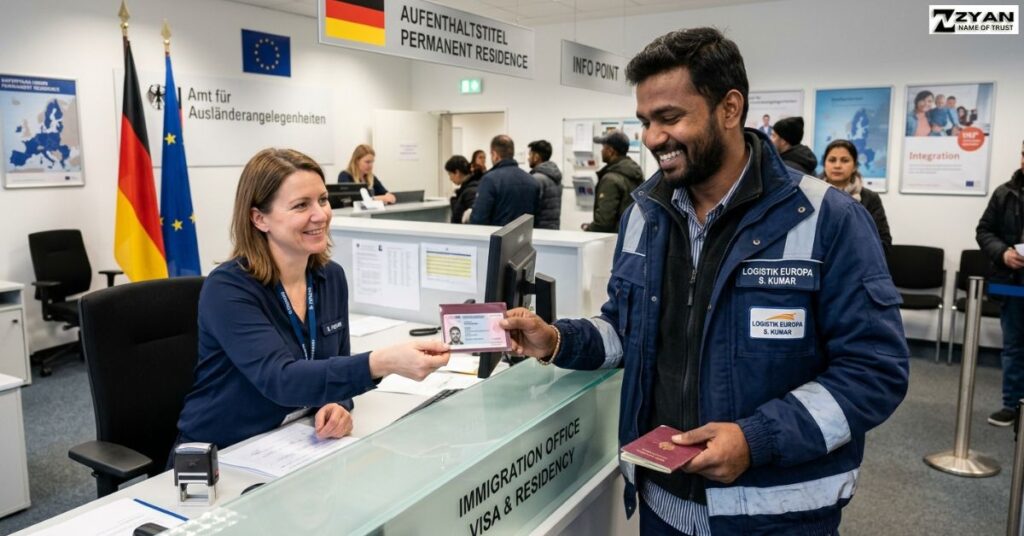
Germany’s work permit to permanent residency Europe pathway for blue collar trades, the Settlement Permit (Niederlassungserlaubnis), typically requires 5 years of legal residence, but this can be reduced to as little as 2–3 years for skilled workers with strong German language proficiency (B1 or higher) and stable employment under Germany’s Skilled Immigration Act provisions. Factory worker PR in Europe and construction worker PR in Europe outcomes in Germany are realistic but depend heavily on language investment.
Czech Republic and Slovakia: lower competition, similar EU timelines
Both Czech Republic and Slovakia offer permanent residency in Europe for workers through the standard EU long-term residence framework, 5 years of continuous legal residence. Demand from Indian blue collar workers has been lower here than Poland or Germany, which can mean faster initial work permit processing and less competitive job markets.
Portugal: an emerging, worker-friendly pathway
Portugal has gained attention as one of the more welcoming Europe immigration pathways for blue collar and low-skilled workers, with a comparatively accessible route to permanent residency (typically 5 years) and a notably faster pathway to citizenship (5 years of legal residence) once PR is granted, among the shortest in the EU.
Romania and Bulgaria: accessible entry, longer-term EU benefits
Romania and Bulgaria are increasingly common entry points for jobs in Europe for Indians in construction and manufacturing. Both follow the standard 5-year EU long-term residence timeline, and a key long-term advantage is that an EU long-term residence permit obtained in one EU country can, under specific conditions, support mobility to work in other EU member states after the initial qualifying period.
Country comparison: PR pathways for blue collar workers in Europe
Country | Standard PR timeline | Language requirement | Best suited trades |
Poland | 5 years | Low for blue collar roles | Construction, warehouse, manufacturing |
Germany | 5 years (2–3 with B1 German + skilled status) | Moderate to high | Skilled trades, factory, construction |
Czech Republic | 5 years | Low to moderate | Manufacturing, construction |
Portugal | 5 years (faster citizenship after) | Low to moderate | Construction, agriculture, hospitality |
Romania | 5 years | Low | Construction, manufacturing |
Bulgaria | 5 years | Low | Construction, manufacturing, logistics |
How Many Years Are Required for PR in Europe? The Real Timeline Explained
The most consistent answer across nearly all European countries offering PR to workers is 5 years of continuous legal residence, this is the standard minimum set by the EU Long-Term Residents Directive, which most EU member states follow for non-EU nationals including Indian workers.
What ‘continuous legal residence’ actually means
This is where many applicants run into trouble. Continuous residence generally means you must not have significant gaps in your legal status, for example, returning to India for an extended period without maintaining your residence permit, or allowing your work permit to lapse between renewals, can reset or interrupt your qualifying period in most countries.
Step-by-step timeline: work permit visa to permanent residency Europe
- Year 0: Obtain your initial work permit visa tied to a specific employer and role
- Years 1–2: Renew your work permit on schedule (annually in most countries); maintain continuous legal employment
- Years 3–4: Continue renewals; some countries allow you to change employers within the same sector without resetting your timeline (verify country-specific rules)
- Year 5: Apply for the EU long-term residence permit or country-specific equivalent settlement status, provided continuous residence and employment requirements are met
- Post-PR: After permanent residency, most countries allow a path to citizenship after an additional period of residence (often 5 more years, sometimes less)
Important Nuance: Germany’s accelerated 2–3 year pathway for skilled workers with B1+ German proficiency shows that the 5-year timeline is not fixed everywhere. Investing in language skills early can meaningfully shorten your path to permanent residency.
Can Factory Workers, Construction Workers, and Truck Drivers Get PR in Europe?
Different blue collar trades face different realities within the broader blue collar workers PR in Europe landscape. Let us look at three of the most common trades Indian workers pursue.
Can construction workers get PR in Europe?
Yes, construction workers PR in Europe represents one of the strongest and most reliable pathways available. Construction labour shortages across Poland, Germany, Romania, and the Czech Republic mean steady demand for work permits, and the standard 5-year EU long-term residence timeline applies cleanly to this trade with no special complications.
Can factory workers get permanent residency in Europe?
Yes, factory worker PR in Europe outcomes are common, particularly in Germany, Poland, and the Czech Republic, where manufacturing sectors actively recruit foreign labour. The main variable is employer stability: factory workers who remain with reliable, registered employers throughout the qualifying period generally face the smoothest path to permanent residency.
Can truck drivers get PR in Europe?
Truck driver PR Europe pathways are growing rapidly, driven by an acute, well-documented shortage of heavy vehicle drivers across the EU, particularly in Poland, Germany, and the Netherlands. Truck driving work permits often come with relatively strong employer sponsorship support, since the labour shortage gives drivers leverage in negotiating longer-term contracts that support continuous residence.
Can labour workers settle permanently in Europe more broadly?
Across nearly every blue collar category, general labourers, warehouse staff, agricultural workers, and hospitality staff, the answer to whether labour workers get PR in Europe is consistently yes, provided the 5-year continuous residence requirement is met and the worker maintains valid legal status throughout. The trade itself matters less than the consistency and legality of the employment relationship.
Is Europe Better Than Gulf Countries for Long-Term Settlement?
This is one of the most important honest comparisons for any worker deciding between regions. The short answer: it depends entirely on whether your goal is maximum short-term income or long-term settlement security.
The Gulf advantage: faster income, no settlement path
Gulf countries (Qatar, UAE, Saudi Arabia) offer tax-free income and fast visa processing, but for the overwhelming majority of blue collar roles, there is no pathway to permanent residency or citizenship at all. Your right to remain ends when your contract ends, regardless of how many years you have worked there.
The Europe advantage: slower start, genuine long-term security
Europe immigration for skilled workers and blue collar trades alike offers something the Gulf structurally cannot: a real, legally defined pathway to permanent residency, family reunification, healthcare access, and eventually citizenship. The trade-off is lower headline salary in the early years and a longer wait before achieving settled status.
Factor | Gulf countries | Europe |
Path to permanent residency | None for most blue collar roles | Yes, typically 5 years |
Initial salary (headline) | Often higher (tax-free) | Often lower (taxed) |
Family settlement | Rare for blue collar visas | Possible after PR in most EU countries |
Long-term security | None, contract-dependent | Strong, PR and eventual citizenship |
Healthcare access | Limited, employer-dependent | Full access after PR in most countries |
Which European Countries Allow Family Sponsorship After PR?
A major advantage of pursuing permanent residency after work visa Europe is family reunification, something almost entirely unavailable under Gulf blue collar work visas.
Family sponsorship rules by country
- Germany: Once you hold a Settlement Permit, you can sponsor your spouse and minor children, generally requiring proof of adequate housing and income
- Poland: Family reunification is available to long-term residents, with the sponsor needing to demonstrate stable accommodation and sufficient income
- Portugal: Among the more accessible family reunification frameworks in the EU, available to residence permit holders even before full PR in many cases
- Czech Republic: Family reunification available to long-term residents, subject to housing and income requirements
- Romania and Bulgaria: Family reunification available under EU long-term resident status, following standard EU directive minimums
Zyan Immigration Insight: Family sponsorship timelines and requirements change periodically as EU member states update their national implementation of the EU Long-Term Residents Directive. Always verify current requirements with an experienced consultant before making firm family relocation plans.
How to Start Your Path Toward Blue Collar Workers PR in Europe
Step 1: Choose the right country for your specific trade
Match your trade to the country with the strongest demand and most accessible pathway. Construction and factory workers should prioritise Poland, Germany, and Romania. Truck drivers should prioritise Poland, Germany, and the Netherlands.
Step 2: Secure a legitimate work permit visa with a verified employer
The foundation of any work visa to PR in Europe journey is a legitimate, verified employer offering a genuine work permit visa, not an informal arrangement or an unverified agent’s promise.
Step 3: Maintain continuous legal residence and employment
Renew your permit on schedule, avoid extended absences from your host country, and keep all employment and residence documentation organised throughout the qualifying period.
Step 4: Invest in language skills where it shortens your timeline
For Germany specifically, and increasingly for other countries, basic host-country language proficiency can meaningfully accelerate your path to permanent residency. Even where not required, language skills improve job stability and integration.
Step 5: Apply for permanent residency once eligible
Once you reach the qualifying residence period, typically 5 years, apply for the EU long-term residence permit or your country’s specific equivalent. This step requires accurate documentation of your continuous residence and employment history.
How Zyan Immigration Helps You Achieve Blue Collar Workers PR in Europe
Zyan Immigration is one of India’s most trusted immigration consultants, with 1058+ verified 5-star reviews on Google and Trustpilot. Headquartered in New Delhi with branches across India, Nepal, the USA, and Dubai, Zyan Immigration has guided thousands of Indian blue collar workers through the full journey from initial work permit to long-term settlement across Europe.
What Zyan Immigration offers for Europe PR aspirants
- Country and trade matching, honest guidance on which European country offers the strongest realistic path to PR for your specific trade
- Verified employer network across Poland, Germany, Romania, Czech Republic, Portugal, and Bulgaria
- Complete work permit visa processing and renewal guidance to maintain continuous legal residence
- Language preparation referrals where accelerated PR timelines depend on host-country language proficiency
- Long-term residence and family sponsorship application support once PR eligibility is reached
- Transparent, itemised service agreements with no hidden fees or guaranteed-outcome promises
If you are searching for a consultancy near me that genuinely understands the long-term Europe PR journey, not just the first work visa, Zyan Immigration’s New Delhi office and branch network make in-person consultation accessible across India.
Frequently Asked Questions:
Can Indians get PR in Europe through blue collar jobs?
Yes. Blue collar workers PR in Europe is genuinely achievable for Indian construction workers, factory employees, truck drivers, and other labour trades. The pathway requires obtaining a legitimate work permit visa, maintaining continuous legal residence and employment for the qualifying period (typically 5 years under the EU Long-Term Residents Directive), and then applying for permanent residency or its country-specific equivalent.
Which European country gives PR easily to workers?
Poland is widely considered among the most accessible European countries offering PR to workers, due to high demand for blue collar labour and a standard 5-year pathway with relatively low language barriers. Portugal, Romania, Bulgaria, and the Czech Republic also offer accessible pathways. Germany offers a potentially faster route (2–3 years) for skilled workers who achieve B1+ German language proficiency.
How many years are required for PR in Europe?
The standard timeline across most EU countries is 5 years of continuous legal residence under a valid work permit, following the EU Long-Term Residents Directive. Some countries, like Germany, offer accelerated pathways of 2–3 years for skilled workers with strong host-country language proficiency and stable employment.
Can construction workers get PR in Europe?
Yes. Construction workers PR in Europe represents one of the strongest pathways available, given persistent labour shortages in this sector across Poland, Germany, Romania, and the Czech Republic. The standard 5-year EU long-term residence timeline applies, and construction roles typically offer stable, renewable work permits that support continuous residence.
Is Europe better than Gulf countries for long-term settlement?
For long-term settlement specifically, yes, Europe offers a structural advantage that the Gulf does not, namely a genuine pathway to permanent residency, family reunification, and eventual citizenship. However, Gulf countries often offer higher initial tax-free income and faster visa processing. The better choice depends on whether your priority is maximum short-term savings (Gulf) or long-term settlement security (Europe).