
Visa scams 2026 are not a distant problem affecting a few unlucky people, they are a fast-growing, well-organised criminal industry targeting hopeful Indian families in nearly every state. This article shares a real, painful account of losing ₹2 lakh to a fake visa agent India operation, and uses that story as the foundation for a complete guide on recognising, avoiding, and recovering from this exact kind of fraud.
If you are currently exploring overseas work, migration, or study opportunities, understanding the patterns behind visa scams 2026 is not optional, it is essential. The story below could be about your neighbour, your cousin, or, without the right precautions, about you.
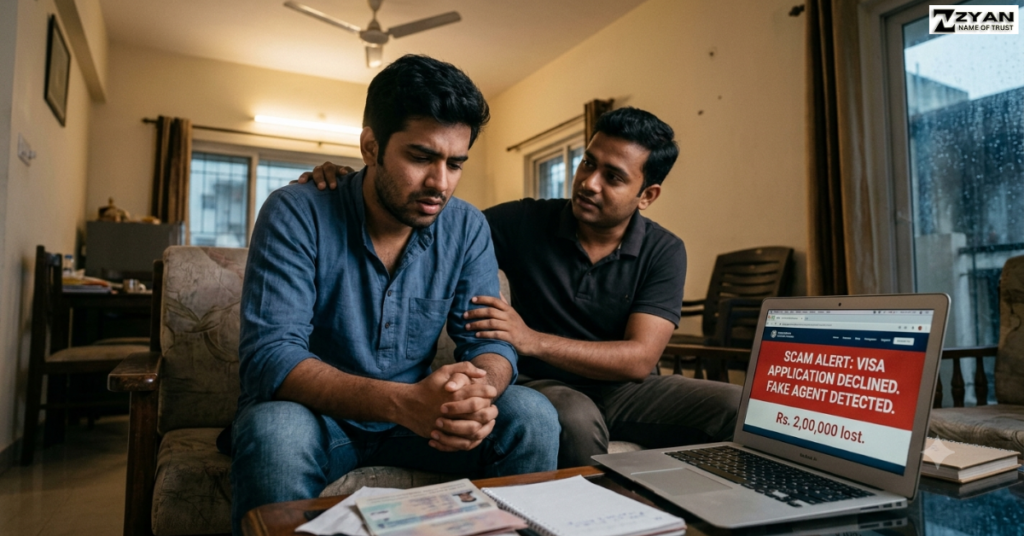
My Story: How I Lost ₹2 Lakh to a Fake Visa Agent
It started with a WhatsApp message from a ‘friend of a friend’
“My cousin shared a number on WhatsApp, said his friend had gone to Germany through this ‘agent’. The man’s name was Rakesh, at least that’s what he told me. He had a slick PDF brochure, talked confidently about a Germany work visa, and quoted a salary that sounded almost too good. I should have paused right there. I didn’t.”
The first red flag I ignored: full payment, in cash, no receipt
“Rakesh said the ‘processing fee’ was ₹1.2 lakh, payable in cash because ‘the embassy charges extra for online transfers’. I now know this makes absolutely no sense, but at the time, eager and a little desperate, I handed over the cash at a roadside café. No invoice. No signed agreement. Just his word and a half-smile.”
The slow fade: excuses, delays, and a second ‘urgent’ payment
“For six weeks it was always ‘processing’. Then he called saying the embassy needed an additional ₹80,000 for ‘insurance and medical clearance’, urgently, within 48 hours, or I would ‘lose my slot’. I borrowed the money from my brother-in-law and paid again. That was the last time I ever spoke to him. His number was disconnected within days.”
The realisation: there was no job, no employer, no visa application
“When I finally tried to verify things independently, I discovered the ‘company’ he claimed to represent in Germany did not exist. No registration. No website beyond a single-page WhatsApp Business profile. I had paid ₹2,00,000 total for a job and a visa that never existed in the first place.”
Why this story matters: This account reflects patterns reported repeatedly to Indian cybercrime cells and consumer forums. The specific names are changed, but the mechanics, WhatsApp introduction, cash-only payment, urgent second demand, then disappearance, are almost identical across thousands of visa scams 2026 cases.
Why Visa Scams 2026 Are More Widespread Than Ever Before
Visa scams 2026 have grown alongside the genuine boom in legitimate overseas opportunities, fraudsters are deliberately riding the wave of real demand for work visa categories, Gulf labour jobs, European work permits, and Canada PR pathways.
The three forces driving the surge
- Genuine demand is at an all-time high, record numbers of Indians are pursuing overseas jobs, making fraudsters’ targeting pool larger than ever
- Digital trust is easily faked, a professional-looking website, a few stock photos, and a confident WhatsApp persona are enough to convince many first-time applicants
- Enforcement remains fragmented, fraudulent operators frequently shut down one number or shell entity and reopen under a new name before action catches up
The financial scale of immigration fraud India faces
Consumer affairs bodies and cybercrime cells across India have documented a consistent rise in immigration fraud India complaints over recent years, with average individual losses ranging from ₹50,000 for smaller visa-processing scams to several lakhs for elaborate fake job offer abroad schemes that include fabricated employment contracts and forged visa stamps.
The 7 Most Common Visa Scams 2026 Patterns You Must Recognise
Understanding the specific mechanics behind visa scams 2026 is the best protection you have. Here are the seven patterns reported most frequently by victims.
Pattern 1: The fake job offer abroad scam
A fake job offer abroad is presented on convincing-looking letterhead, often for Gulf, European, or Southeast Asian roles. The ’employer’ does not exist, or exists but never made the offer. Victims pay ‘processing’ or ‘documentation’ fees for a job that was fabricated from the start.
Pattern 2: The work visa scam with a fake stamp or sticker
In more elaborate work visa scam operations, fraudsters produce convincing-looking (but entirely fake) visa stickers or stamps in the victim’s passport. The victim believes they have a valid visa until they are denied boarding at the airport or detained on arrival.
Pattern 3: The fake work permit scam using real company names
A fake work permit scam sometimes uses the name of a real, legitimate company abroad, without that company’s knowledge, to appear more credible. Victims only discover the fraud when they try to contact the actual company directly, who has no record of hiring them.
Pattern 4: Overseas employment fraud through fake recruitment drives
Overseas employment fraud often takes the form of a fake ‘recruitment drive’ or walk-in interview event, sometimes held at a rented hotel conference room for a single day to appear legitimate. Victims pay a registration or processing fee on the spot and never hear from the organisers again.
Pattern 5: Work permit fraud through fabricated LMIA or sponsorship letters
For Canada-bound applicants specifically, work permit fraud frequently involves fabricated Labour Market Impact Assessment (LMIA) approval letters or fake employer sponsorship documents, documents that look official but were never filed with or approved by the actual Canadian authorities.
Pattern 6: The overseas job scam via social media and influencer-style ads
A growing share of overseas job scam cases now originate from Instagram and Facebook ads featuring testimonial-style videos of supposedly successful clients. These ads often run for a short window, target specific regions, and disappear once enough victims have paid.
Pattern 7: Visa consultant fraud disguised as a ‘guaranteed approval’ service
Perhaps the most damaging form of visa consultant fraud is the explicit promise of guaranteed visa approval, something no legitimate consultant can ever offer, since the final decision always rests with the destination country’s government. This promise alone should end the conversation immediately.
Scam pattern | Typical loss range | Primary red flag |
Fake job offer abroad | ₹50,000–₹3,00,000 | No verifiable employer registration |
Fake visa sticker/stamp | ₹1,00,000–₹5,00,000 | No appointment record at the actual embassy |
Fake work permit using real company name | ₹80,000–₹2,50,000 | Real company has no record of the offer |
Fake recruitment drive | ₹10,000–₹50,000 | One-day event, no follow-up contact possible |
Fabricated LMIA/sponsorship letter | ₹1,50,000–₹4,00,000 | Document not verifiable on official portals |
Social media overseas job scam | ₹20,000–₹1,00,000 | Ad disappears after a short run |
Guaranteed approval visa consultant fraud | ₹50,000–₹3,00,000+ | Explicit guarantee of visa success |
How to Identify Fake Visa Agents: The Verification Checklist Every Applicant Needs
Knowing how to identify fake visa agents before you pay anything is the single most powerful defence against visa scams 2026. Here is the complete verification process.
Step 1: Insist on a registered business identity
- Ask for the company’s registration number and verify it on the Ministry of Corporate Affairs (mca.gov.in) portal
- Request the GSTIN and verify it on the GST portal (gst.gov.in)
- Confirm there is a real, visitable physical office, not just a WhatsApp number
Step 2: Learn how to verify an immigration consultant against destination-country regulators
How to verify an immigration consultant properly means checking destination-country specific registers where applicable: CICC for Canada, OISC for the UK, MARA for Australia, and IAA for New Zealand. A consultant claiming expertise in these countries without appearing on the relevant register is a serious warning sign.
Step 3: Demand a written, itemised agreement before any payment
Never pay any amount, large or small, without a signed, itemised service agreement specifying exactly what each fee covers, the expected timeline, and the refund policy if the application is unsuccessful.
Step 4: Never pay in cash without a receipt
Note: Cash payment with no receipt was the single decision that made recovery nearly impossible in the story shared above. Always insist on a bank transfer, cheque, or digital payment with a proper invoice, this alone eliminates the majority of fake visa agent India operations, who specifically avoid traceable payment methods.
Step 5: Treat any ‘guaranteed approval’ claim as an automatic red flag
No legitimate consultant, anywhere in the world, can guarantee visa approval. This single phrase, more than any other, separates genuine immigration consultants from fraudulent ones.
I've Lost Money to a Visa Agent. What Do I Do Now?
If you have already lost money to a visa agent, time matters enormously. Here is exactly what to do, in order.
Immediate steps within the first 24 hours
- Stop all further payments immediately, regardless of what new urgency or excuse is presented
- Gather every piece of evidence, WhatsApp chats, call recordings if available, payment receipts, bank transfer records, the agent’s claimed business name and any documents they shared
- If payment was made via bank transfer or UPI, immediately contact your bank to report the transaction and request a freeze if the funds have not yet been withdrawn
- File a complaint on India’s National Cyber Crime Reporting Portal at cybercrime.gov.in, this is the fastest official route for a cyber crime visa scam report
Filing a formal visa fraud complaint India report
A proper visa fraud complaint India should be filed through multiple channels simultaneously to maximise your chances of action and recovery.
Where to file | What it covers |
cybercrime.gov.in (National Cyber Crime Reporting Portal) | Online/digital fraud, UPI and bank transfer scams |
Local police station (FIR) | Formal criminal complaint, required for most legal recovery processes |
Consumer protection complaint against the business | |
Ministry of External Affairs (Protector of Emigrants) | Relevant if the fraud involved overseas employment/eMigrate violations |
State Police Cyber Crime Cell (in person) | Detailed investigation support, especially for larger losses |
Documents to prepare before filing your complaint
- All chat records (WhatsApp, SMS, email) with the agent, do not delete the conversation thread
- Bank statements or UPI transaction records showing the payment(s) made
- Any documents, brochures, or offer letters the agent provided
- The agent’s phone number, claimed business name, and any social media profiles used
- A clear, written timeline of events from first contact to the point you realised it was fraud
Recovery reality check: Full financial recovery is not guaranteed, particularly in cash-payment cases. However, filing promptly significantly improves your chances if any traceable payment method was used, and your report helps authorities build cases against repeat offenders, protecting future victims even if your own funds cannot be fully recovered.
Beyond the Money: Processing the Emotional Impact of Visa Fraud
Losing money to a fake visa agent India scam is not just a financial setback. Victims commonly describe feelings of shame, self-blame, and reluctance to tell family members what happened, which often delays reporting and recovery.
It is worth saying clearly: falling victim to a well-organised scam does not reflect poorly on your intelligence or judgement. These operations are deliberately designed to exploit hope, urgency, and trust, the same qualities that make someone a good, trusting person are exactly what fraudsters target. Reporting the incident, talking to family, and seeking support is not embarrassing. It is the responsible next step.
How Zyan Immigration Protects You From Visa Scams 2026
Zyan Immigration is one of India’s most trusted immigration consultants, with 1058+ verified 5-star reviews on Google and Trustpilot. Headquartered in New Delhi with branches across India, Nepal, the USA, and Dubai, Zyan Immigration was built specifically to give applicants the transparency that fraudulent operators deliberately avoid.
How Zyan Immigration’s process is designed to prevent visa scams 2026 risk
- Fully registered Indian business entity with verifiable registration details provided on request
- Physical offices across multiple cities and countries, verifiable through Google Business Profile
- 1058+ genuine, detailed reviews on Google and Trustpilot reflecting real client experiences
- Written, itemised service agreements provided before any payment is collected, never cash-only, never undocumented
- Honest eligibility assessments, never a guaranteed approval claim
- Verified employer relationships for Gulf, European, and other work visa categories, no fabricated job offers
- Free initial consultation, allowing every prospective client to evaluate transparency before committing to any paid service.
Frequently Asked Questions:
What are the most common visa scams 2026 patterns in India?
The most common visa scams 2026 patterns include fake job offers abroad with fabricated employer details, fake visa stickers or stamps placed in the victim’s passport, fake work permits using real company names without their knowledge, fraudulent one-day recruitment drives, fabricated LMIA or sponsorship letters for Canada-bound applicants, social media-driven overseas job scams, and visa consultant fraud built around guaranteed approval promises.
How can I tell if a visa agent is fake before paying them?
Learning how to identify fake visa agents involves several checks: verify their business registration on the MCA or GST portal, confirm any claimed destination-country regulatory registration (such as CICC for Canada or OISC for the UK), insist on a written and itemised service agreement, never pay in cash without a receipt, and treat any guarantee of visa approval as an automatic red flag, since no legitimate consultant can promise this.
I already lost money to a visa agent. What should I do first?
If you have lost money to a visa agent, stop all further payments immediately, gather every piece of evidence including chat records and payment proof, and if the payment was made via bank transfer or UPI, contact your bank immediately to report the transaction. File a complaint on India’s National Cyber Crime Reporting Portal (cybercrime.gov.in) and at your local police station as soon as possible, acting within the first 24–48 hours significantly improves recovery chances.
Where can I file a visa fraud complaint in India?
A visa fraud complaint India can be filed through multiple channels: the National Cyber Crime Reporting Portal (cybercrime.gov.in) for digital and payment-related fraud, a local police station for a formal FIR, the National Consumer Helpline (1915) for consumer protection complaints, and the Ministry of External Affairs’ Protector of Emigrants office if the fraud involved overseas employment or eMigrate violations.
How do I verify an immigration consultant is legitimate before paying them?
Knowing how to verify an immigration consultant involves checking their business registration on India’s MCA or GST portal, confirming registration with the relevant destination-country regulator if applicable (CICC, OISC, MARA, IAA), verifying a real physical office address, reading detailed and genuine reviews across multiple independent platforms, and insisting on a signed, itemised service agreement before any payment is made.